
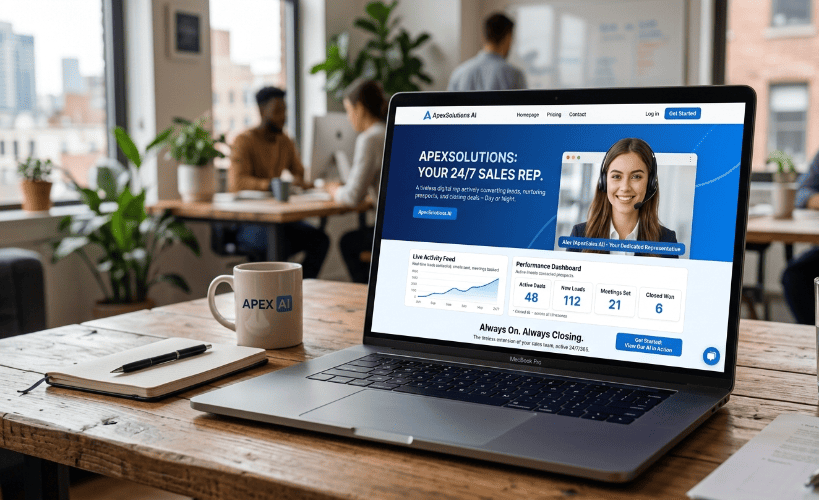
Most business owners think about their website the wrong way.
They think of it as a brochure — something to have so people can verify you’re legitimate, find your phone number, and confirm you exist. It’s a presence, not a tool. Something to build once, update occasionally, and largely forget about.
The businesses growing fastest online think about their website completely differently. For them, the website is a sales representative. It works around the clock, never takes a sick day, handles the same questions patiently for the hundredth time, and — when built correctly — qualifies prospects and moves them toward a decision before they ever pick up the phone.
The difference in revenue between these two approaches, compounded over two or three years, is enormous. Here’s what the second approach actually looks like.
The Sales Rep Analogy
Think about your best salesperson — or, if you’re a solo operator, think about yourself at your best in a sales conversation.
What do they do well? They listen to what the customer actually needs. They explain the service clearly, without jargon. They answer objections before they’re raised. They communicate credibility — why you’re the right choice, not just any choice. They make the next step obvious and easy. They follow up.
A well-built, well-optimized website does all of these things. A brochure website does none of them.
The question is which kind of website yours is.
The First Job: Being Found
A sales representative who sits in a locked office and waits for customers to find them isn’t very useful. The first job of your website is to be discoverable — to show up when potential customers are actively looking for what you offer.
This is where SEO enters the picture. Traditional search engine optimization ensures that when someone in Almaty searches for a dentist, a restaurant, or a lawyer with the right characteristics, your website appears in the results. This is not magic — it’s a combination of technical fundamentals, content quality, and the authority signals you’ve built over time.
But as we’ve discussed elsewhere, discovery now happens across multiple channels. Google, yes — but also 2GIS, Yandex, ChatGPT, Perplexity, and Google’s own AI Overviews. A modern SEO strategy ensures you’re discoverable across all of these touchpoints, not just one.
The Second Job: Building Trust Immediately
When a potential customer lands on your website, you have approximately three to five seconds before they decide whether to stay or leave. In that moment, they’re making an unconscious judgment: does this seem like a real, trustworthy business?
This judgment is made visually and emotionally before any content is read. A slow-loading, outdated-looking website with stock photos and generic text fails this test immediately, regardless of how good the actual business is.
A well-designed, fast, mobile-optimized website with genuine photos, real team information, and specific (not generic) content passes this test. The visitor relaxes slightly and begins actually reading.
This is why website quality and SEO are inseparable. Ranking well but delivering a poor experience is worse than not ranking at all — it burns potential customers who might otherwise have become clients.
The Third Job: Answering Every Question
Here’s where the sales rep analogy becomes most powerful.
Think about every question a potential customer asks before deciding to work with you. For a dental clinic: What procedures do you offer? How much does it cost? Does it hurt? How long will it take? What are your qualifications? What do other patients say? How do I book?
For a law firm: Do you handle cases like mine? What does the process look like? How much will this cost? How long does it typically take? What are my chances?
For a restaurant: What kind of food? What’s the atmosphere like? Do you take reservations? What’s the price range? Is there parking?
Every one of these questions that goes unanswered on your website is a reason for a potential customer to either call a competitor or simply not follow through. Every question that is answered clearly and honestly is a step toward conversion.
The best websites answer every reasonable question a prospect might have — and they do it in the customer’s language, not in industry jargon.
The Fourth Job: Converting Visitors Into Actions
A great sales rep doesn’t just inform — they guide. At the right moment, they ask for the next step. They make it easy to say yes.
Your website should do the same. Every page should have a clear, obvious next action: Book an appointment. Send a WhatsApp message. Call now. Fill out this form.
The mechanics matter too. If your contact form is buried three clicks deep, you’re losing conversions. If your WhatsApp button is only on the contact page and not visible throughout the site, you’re losing conversions. If your phone number isn’t clickable on mobile, you’re losing conversions.
These are not complicated fixes. They’re the digital equivalent of making sure your front door is unlocked and clearly labeled.
The Fifth Job: Working While You Sleep
Here’s the compounding advantage of treating your website as a sales representative rather than a brochure.
A salesperson works eight hours a day, five days a week. Your website works every hour of every day, indefinitely. A customer who wakes up at 2 AM with a toothache, or who researches law firms during their lunch break, or who browses restaurants while waiting for a bus — they can all interact with your website and move toward a decision without you being present.
More importantly, the quality of your website’s content — the articles you publish, the questions you answer, the trust signals you accumulate — compounds over time. A blog post you publish today might generate inquiries for the next three years. A collection of genuine reviews builds a trust profile that new visitors draw on months or years after those reviews were written.
This is why SEO, properly understood, is not an expense — it’s an investment. Unlike paid advertising, which generates returns only while you’re paying for it, a well-built digital presence continues generating returns long after the initial investment.
Putting It Together
The most effective websites I’ve built for businesses in Almaty and Bishkek combine several elements: technically solid and fast, designed to build immediate trust, structured to answer every customer question, optimized for AI citation as well as traditional search, and built to convert visitors into actions.
None of these elements is optional. A website that ranks well but converts poorly is leaving money on the table. A website that looks great but nobody finds is a beautiful brochure sitting in an empty room.
When all the elements work together — discovery, trust, information, conversion — the website becomes something genuinely valuable: a sales representative that works around the clock, serves every market simultaneously, and gets better over time as content accumulates and authority builds.
If your current website isn’t doing all of these things, you’re not getting full value from your digital presence. I help businesses in Almaty and Bishkek build and optimize websites that perform across all of these dimensions — not just look good, but actually generate clients. If that sounds like what you need, let’s have a conversation.